

The Silent Career Advantage Nobody Talks About
Nobody in your industry is going to tell you this in a meeting. It won't come up in your annual review. Your mentor probably won't bring it up either ... even if they know it's true.
But the data is clear. And the highest-performing professionals, the ones quietly pulling ahead, already know it.
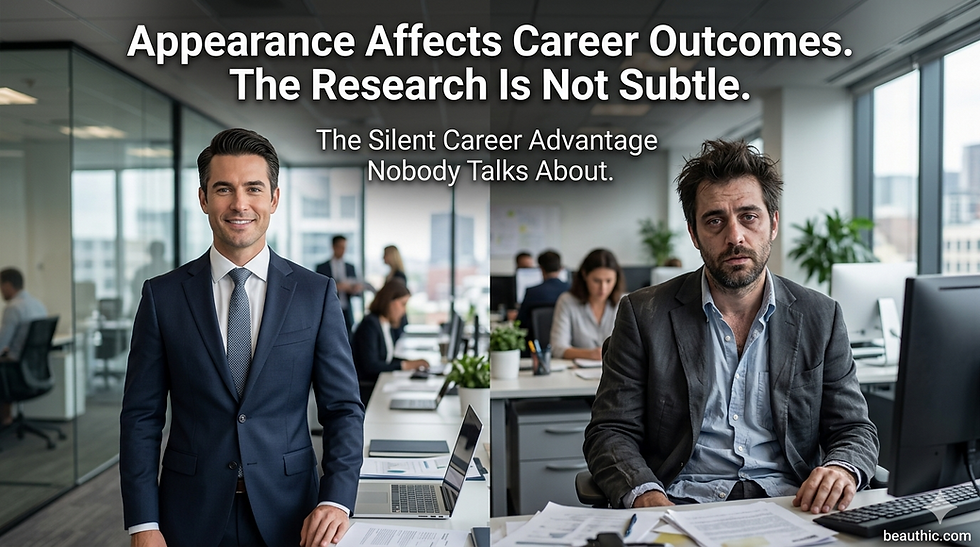
Appearance Affects Career Outcomes. The Research Is Not Subtle.
Economists have a term for it: "lookism." It refers to the measurable, documented bias that causes more attractive or well-presented individuals to be perceived as more capable, more trustworthy, and more leader-like — and to be paid more, promoted faster, and given more opportunities as a result.
This isn't a fringe theory. It shows up in decades of peer-reviewed research across economics, psychology, and organisational behaviour. Some of the key findings:
Economist Daniel Hamermesh found that attractive workers earn 10–15% more over a lifetime than their less-attractive peers — a "beauty premium" that compounds across an entire career.
A University of Kansas study found that people consistently rate well-presented individuals as more intelligent and competent — before they've spoken a single word.
Research published in the Journal of Applied Psychology found that facial maturity cues — including tiredness, stress lines, and heaviness around the eyes — directly affect perceived leadership potential in professional assessments.
A Harvard Business Review analysis confirmed that executives rated as more physically vital and energetic were more likely to be promoted to senior leadership — regardless of actual health status.
To be clear: none of this means talent doesn't matter. It does. But in competitive environments where multiple candidates are equally skilled, qualified, and experienced, appearance becomes a differentiating signal — whether anyone admits it or not.
"The research doesn't say good-looking people are smarter. It says they are perceived as smarter — and in professional environments, perception shapes opportunity."
The Specific Signals That Work Against You in Professional Settings
It's not about being conventionally attractive. That's not the point, and it's largely not in your control. What is in your control — and what research shows has the most professional impact — are the visual signals your face sends about your energy level and emotional state.
So what are the 'Appearance Affects Career Outcomes' signs?
Three specific facial signals are consistently associated with negative professional perception:
Looking tired: Under-eye hollowing, heavy upper lids, and dull skin register subconsciously as low energy and disengagement — even on a person who slept 8 hours and is fully alert.
Looking stressed or angry at rest: Deep frown lines between the brows — the "11s" — make people appear permanently tense, irritable, or unapproachable, even during neutral conversation. Studies on resting facial expression show this directly impacts how trustworthy and approachable a person is rated.
Looking older than your actual age: When your face reads as significantly older than your biological age — due to stress, poor sleep compounding over years, or simply genetics — it affects perceived vitality. And vitality, research shows, is one of the top proxies for perceived leadership ability.
None of these signals reflect reality. The tired-looking man may be the sharpest person in the room. The frowning face may belong to someone deeply warm and collaborative. But these signals fire before anyone has a chance to demonstrate who they actually are.
What High Performers Are Actually Doing — And Not Saying
The aesthetics industry has data that the career development industry doesn't talk about: the fastest-growing demographic booking non-surgical aesthetic treatments is men aged 30–55 in professional occupations.
These aren't men chasing youth or trying to look like someone else. They're men who understand that in high-stakes environments — the boardroom, the investor meeting, the promotion panel — every signal matters. And they're optimising the signals they can control.
The treatments are mostly non-surgical, fast, and designed for invisibility. The goal is never to look "done" — it's to remove the signals that contradict who you actually are.
The Professional Toolkit: What's Being Used and Why
Anti-wrinkle injections (Botox): Softens frown lines and forehead creases that signal stress and age. The most common first step for professional men. Results are subtle — colleagues notice you look fresher, not different. Done in under 30 minutes, no downtime.
Tear trough filler: Addresses the hollow under the eye that creates the "permanently tired" look. Often a single treatment provides 12–18 months of results. One of the highest-impact changes for professional appearance.
Skin boosters and bioremodellers (e.g. Profhilo): Improve skin quality, hydration, and radiance without changing facial structure. The result reads as healthy, well-rested, and vital — exactly the signals that matter in professional environments.
Masseter Botox (jaw relaxing): Reduces a bulky, tense jawline and relieves chronic jaw clenching — a physical symptom of stress that is also visually associated with tension and aggression. Particularly valuable for men in leadership roles where approachability matters.
Why Nobody Talks About This
Because it's an advantage. And advantages, when they're real, are rarely discussed openly.
The man who optimises his sleep, nutrition, fitness, wardrobe, and communication style for professional performance doesn't announce it. He just performs better. Aesthetic treatments have quietly joined that list of performance inputs — and the professionals using them are not going to mention it at the next team away day.
There's also the stigma factor — which is real but eroding. The same man who would have laughed at the idea five years ago is now quietly booking. He just doesn't post about it. That's fine. The results are the point.
This Is Not About Vanity. It Never Was.
Vanity is caring about how you look for its own sake. This is different. This is understanding that in a competitive professional environment, you are being assessed constantly — in hallway conversations, in video calls, in presentations, in the three seconds before you open your mouth — and that managing those signals is simply good strategy.
You already do this in a hundred other ways. You wear clothes that fit well. You prepare for presentations. You choose your words carefully. You get enough sleep when you can. This is the same logic — applied to a domain most people haven't thought about yet.
"The question isn't whether appearance affects your career. The research settled that decades ago. The question is: what are you going to do about it?"
Where to Start
If you've noticed that your face is sending signals that don't match who you are — that you look more tired, stressed, or older than you feel — a no-obligation consultation with a practitioner who specialises in treating professional men is the most useful first step.
You don't need to commit to anything. You just need to understand what's available, what it does, and whether it fits your situation. That conversation takes 15 minutes. The advantage it unlocks can last years.
Interested in more? Subscribe to our page and get daily updates to the latest trends.


Comments