

Why You Still Look Tired and What High Performers Do Differently: How to look less tired as a man!

Most men don't realise this, but you can look exhausted even when you are not!
In this blog we will discuss why and how how to look less tired as a man.
But in meetings, on Zoom, or under office lighting, your face tells a different story.
And people notice.
Not directly. Not consciously.But it changes how you’re perceived.
Less sharp. Less energised. Less in control.
This is not about vanity.It is about signal.
In high-performance environments, how you look influences how your energy, authority, and competence are interpreted. And the gap between how you feel and how you appear is where many professionals quietly lose ground.
Why You Still Look Tired Even After Rest
f you have ever thought, “I feel fine, so why do I look like this?”, the answer usually comes down to a few specific visual cues..
1. The Eye Area Carries Most of the Signal

The area under your eyes plays a disproportionate role in how alert you look.
Hollowing can create shadows
Mild puffiness adds heaviness
Skin thinning makes darkness more visible
Even small changes here can make your entire face look drained, especially on camera.
2. Skin Quality Affects How Light Hits Your Face

Healthy skin reflects light evenly. When that changes, your face can appear dull or flat.
Uneven tone creates a “fatigue effect”
Loss of brightness reduces definition
Texture can make shadows more pronounced
This is why you may look fine in one mirror but noticeably more tired on Zoom or in office lighting.
3. Subtle Structural Changes After 30
From your early 30s, small shifts begin to happen:
Slight volume loss around the eyes and cheeks
Early lines that hold shadow
A heavier or less defined lower face
Individually, these changes are minor. Together, they create a baseline where your face starts to default to “tired”.
Here is the key point most men miss:
You are not necessarily tired.Your face is simply signalling that you are.

Why This Impacts How You’re Perceived at Work
In professional environments, perception is fast and often subconscious.
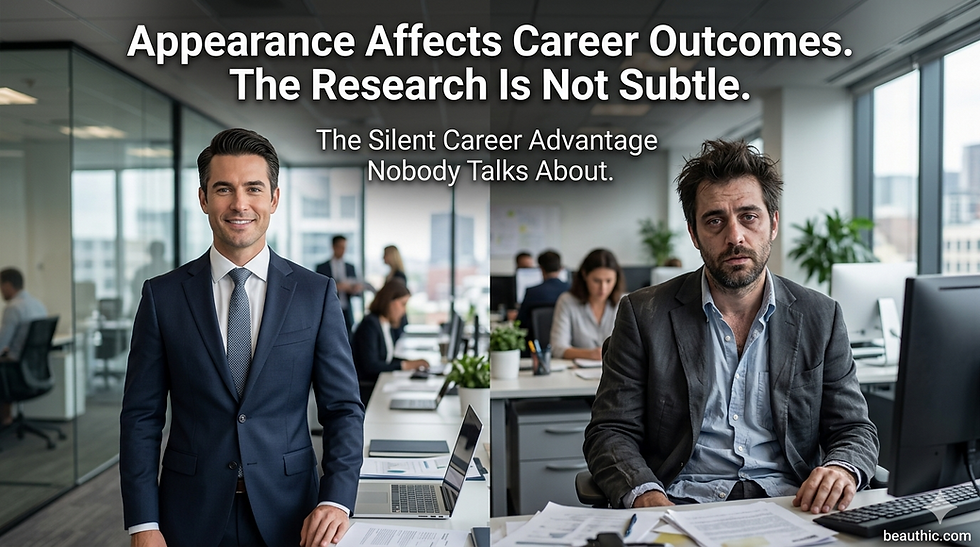
Two people can be equally capable. The one who looks more alert and composed is more likely to be seen as:
more reliable
more in control
more capable under pressure
This is not always fair, but it is consistent.
And in environments where decisions happen quickly, small visual cues carry weight.
What High Performers Do Differently
High-performing men are not immune to stress, long hours, or poor sleep.
They simply manage how those factors show up.
Instead of trying to eliminate fatigue completely, they focus on reducing the visible signals of it.
That means maintaining:
a clear, bright eye area
consistent skin quality
a face that reads as “rested”, even when they are not
The difference is subtle, but the impact is not.
The Shift: From “Looking Better” to Removing Negative Signals
This is where most people get it wrong.
The goal is not to change how you look.It is to remove what is working against you.
There are now clinically-backed ways to:
reduce under-eye shadowing
improve skin clarity and light reflection
restore small areas where the face starts to look drawn or fatigued
These are not dramatic changes.
They are small, targeted adjustments designed to bring your appearance back in line with how you actually feel.
Think of it as alignment, not enhancement.
What This Looks Like in Practice
Modern approaches focus on subtlety and efficiency.
Most options:
take under an hour
involve minimal interruption to your routine
are designed to look completely natural
The outcome is simple:
You still look like yourself, just more awake, sharper, and more in control.
No one can point to what changed.They just register a different impression.
Why This Matters More Now
The way we work has changed.
More video calls
More exposure to harsh, unflattering lighting
More digital visibility through profiles and content
Faster judgement windows
You are often being assessed in seconds, sometimes before you even speak.
In that context, looking consistently energised is no longer a nice-to-have. It is part of how you present professionally.
If You’ve Ever Heard “You Look Tired”
Even when you feel fine, that comment is feedback.
Not about your effort. Not about your performance.But about how your face is being interpreted.
Understanding what is driving that signal is the first step.
Because once you see it clearly, it becomes something you can control.
What to Look for If You Explore Solutions
If you decide to go deeper, focus on:
subtle, natural outcomes
approaches that reduce fatigue signals, not change your identity
experienced practitioners who prioritise restraint over transformation
The best results are the ones no one can detect.
At the end of the day.....
This is not about looking different.
It is about removing the disconnect between:
how you perform
and how you are perceived
And in high-performance environments, that gap matters more than most realise.
If you want to understand what specific options look like in practice, explore our in-depth guides or compare trusted clinics that specialise in natural, low-downtime approaches.
Contact us today and book a consultation!
Stay in the know as we will continue elaborating on this topic: sign up to our community!
Comments